
MCAT Exam Overview
Everything you need to know about the MCAT — format, sections, timing, and scoring — from San Diego's top-rated MCAT tutor.
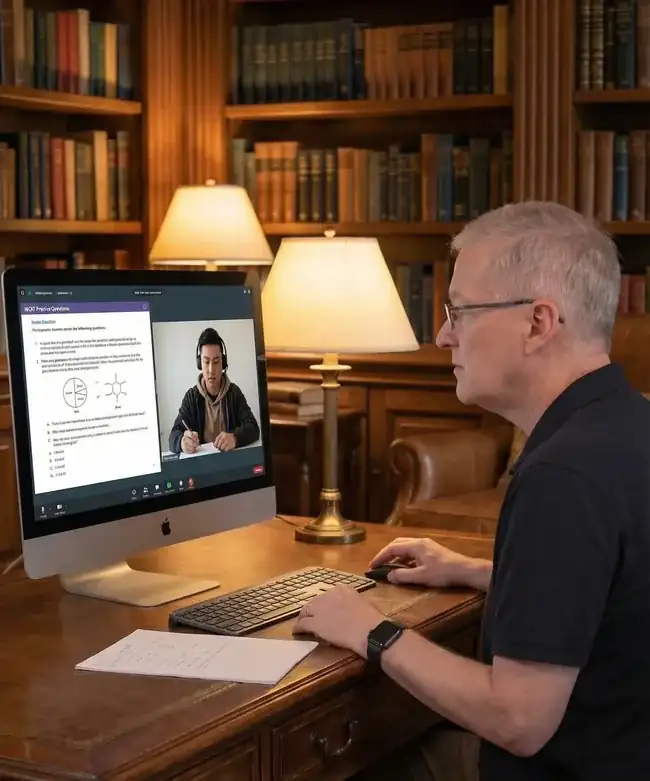
What Is the MCAT?
The Medical College Admission Test (MCAT) is a standardized, computer-based exam administered by the Association of American Medical Colleges (AAMC). It is a required component of the admissions process at virtually every allopathic (MD) and osteopathic (DO) medical school in the United States and Canada.
The MCAT is designed to assess your problem-solving ability, critical thinking, scientific knowledge, and understanding of principles prerequisite to the study of medicine. It is not simply a content test — the exam rewards the ability to analyze passages, interpret data, and apply concepts to unfamiliar scenarios.
Understanding the structure and scoring of the MCAT is the first step toward building an effective study plan. Below, Dr. Donnelly breaks down everything you need to know about the exam format, its four scored sections, timing, and how scores are calculated.
MCAT Exam Structure at a Glance
The MCAT is a 7-hour, 30-minute exam consisting of four scored sections and 230 questions. Here is the complete breakdown of the exam day timeline.
4 Sections
The exam is divided into four independently scored sections, each testing a distinct combination of scientific knowledge and reasoning skills.
230 Questions
You will answer 230 multiple-choice questions across the four sections. Every question has four answer choices, with one correct answer.
6 hrs 15 min
Total seated testing time is approximately 6 hours and 15 minutes. With breaks, your total time at the testing center is roughly 7.5 hours.
472–528 Scale
Each section is scored on a scale of 118–132, with 125 as the midpoint. The four scores combine for a composite range of 472–528.
Biological & Biochemical Foundations of Living Systems
The Biological and Biochemical Foundations of Living Systems section tests your knowledge of biological and biochemical processes that underlie human physiology and disease. It is one of the most content-heavy sections on the MCAT, requiring a solid foundation in biology, biochemistry, organic chemistry, and general chemistry.
This section contains 59 questions and you have 95 minutes to complete it. Questions are passage-based (approximately 10 passages with 4–7 questions each) and discrete (stand-alone questions not tied to a passage).
Key topics include: amino acid structure and function, enzyme kinetics, metabolic pathways (glycolysis, Krebs cycle, oxidative phosphorylation), molecular biology (DNA replication, transcription, translation), organ systems physiology, cell biology, genetics, and the endocrine system.
Dr. Donnelly's approach to this section focuses on understanding underlying mechanisms rather than rote memorization. He teaches students to extract key information from dense experimental passages quickly and efficiently — a skill that distinguishes top scorers from average ones.
Section Snapshot
- Questions: 59
- Time: 95 minutes
- Passages: ~10
- Score Range: 118–132
- Core Subjects: Biology, Biochemistry, Organic Chemistry, General Chemistry
Chemical & Physical Foundations of Biological Systems
Section Snapshot
- Questions: 59
- Time: 95 minutes
- Passages: ~10
- Score Range: 118–132
- Core Subjects: General Chemistry, Physics, Organic Chemistry, Biochemistry
The Chemical and Physical Foundations of Biological Systems section tests your ability to apply knowledge of general chemistry, organic chemistry, physics, and biochemistry to solve problems within a biological context. This section often intimidates students because of its heavy quantitative demands.
Like the Bio/Biochem section, it contains 59 questions with a 95-minute time limit. Expect approximately 10 passages with associated questions, plus a handful of discrete (stand-alone) questions.
Key topics include: kinematics and dynamics, thermodynamics and kinetics, fluid mechanics, electrostatics, optics, atomic structure, bonding, stoichiometry, acid–base chemistry, electrochemistry, and the physical properties of biological molecules.
Many students struggle with the physics content in this section because MCAT physics questions are embedded in biological passages rather than presented as straightforward calculations. Dr. Donnelly teaches his students a systematic approach to identifying the underlying physics principles in each passage and applying them efficiently — often without needing a calculator.
Critical Analysis and Reasoning Skills (CARS)
The CARS section is unlike any other section on the MCAT. It does not test scientific knowledge at all. Instead, it evaluates your ability to read complex, often unfamiliar passages drawn from the humanities and social sciences and answer questions that require comprehension, analysis, and reasoning beyond the text.
CARS contains 53 questions and you have 90 minutes to complete them. The section includes 9 passages, each followed by 5–7 questions. Passages are drawn from disciplines such as philosophy, ethics, cultural studies, political science, art history, and economics.
Question types include: foundations of comprehension (understanding what the passage says), reasoning within the text (drawing inferences from stated information), and reasoning beyond the text (applying the author's ideas to new contexts or evaluating their implications).
CARS is widely considered the most difficult section to improve on, but Dr. Donnelly disagrees. His proprietary passage-mapping technique teaches students to build a mental roadmap of each passage in under two minutes, dramatically improving both accuracy and pacing. Students who apply these methods consistently report CARS as one of their strongest sections on test day.
Unlike the science sections, CARS cannot be crammed. It rewards regular, focused practice over months of preparation. Dr. Donnelly builds dedicated CARS practice into every student's study plan from day one.
Section Snapshot
- Questions: 53
- Time: 90 minutes
- Passages: 9
- Score Range: 118–132
- Content: Humanities & Social Sciences (no science)
Psychological, Social & Biological Foundations of Behavior
Section Snapshot
- Questions: 59
- Time: 95 minutes
- Passages: ~10
- Score Range: 118–132
- Core Subjects: Psychology, Sociology, Biology
The Psychological, Social, and Biological Foundations of Behavior section was added to the MCAT in 2015 to test knowledge of the behavioral and sociocultural determinants of health. It examines how psychological, social, and biological factors influence perceptions, reactions, and health outcomes.
This section contains 59 questions and you have 95 minutes to complete it. As with other sections, questions are a mix of passage-based and discrete formats.
Key topics include: sensation and perception, learning and memory, cognition and consciousness, motivation and emotion, identity and personality, social processes, attitude formation, demographic characteristics, social inequality, and the biological bases of behavior (neurotransmitters, the nervous system, the endocrine system).
Students often underestimate this section because they assume psychology and sociology are "easy" subjects. In reality, the Psych/Soc section requires precise recall of hundreds of terms, theories, and experimental findings. The passages frequently present research studies, and questions demand that you evaluate experimental design, identify confounding variables, and distinguish correlation from causation.
Dr. Donnelly's tutoring for this section focuses on building a structured mental framework for the enormous volume of terminology, paired with strategies for tackling research-methodology passages — the most common question trap on exam day.
How MCAT Scoring Works: 472–528 Explained
Raw Score to Scaled Score
Your raw score on each MCAT section (the number of questions answered correctly) is converted to a scaled score ranging from 118 to 132, with 125 representing the approximate midpoint. There is no penalty for wrong answers, so you should answer every question even if you must guess.
The four section scores combine to produce a composite score ranging from 472 to 528. The median composite score is approximately 500, corresponding to roughly the 50th percentile.
What Is a Competitive MCAT Score?
A score of 510 (roughly the 80th percentile) is generally considered competitive for most allopathic medical schools. The most selective programs — including top-20 schools — typically expect scores of 515+ (92nd percentile or higher). DrMCAT students average a 516 composite, placing them squarely in the top tier of MCAT test takers.
Percentile rankings are recalculated annually based on recent test-taker performance. Because the MCAT is curved, your percentile position depends not only on your raw accuracy but also on how you compare to others who took the same exam.
Score Release Timeline
MCAT scores are typically released approximately 30–35 days after your test date. You will receive an email from the AAMC when your score report is available. The report includes your section scores, composite score, percentile ranks, and confidence bands.
Common MCAT Score Benchmarks
| Score | Percentile | Competitiveness |
|---|---|---|
| 524+ | 99th+ | Elite / Top 5 schools |
| 518–523 | 96th–99th | Highly competitive |
| 514–517 | 90th–95th | Strong / Top 20 schools |
| 510–513 | 80th–89th | Competitive |
| 505–509 | 66th–79th | Average / Some MD schools |
| 500–504 | 50th–65th | Below average for MD |
MCAT Preparation Strategies from Dr. Donnelly
With 20+ years of MCAT tutoring experience and 500+ students coached, Dr. Donnelly has identified the strategies that consistently produce the biggest score gains.
Start with a Diagnostic
Take a full-length AAMC practice exam before you begin studying. This baseline score reveals your true strengths and weaknesses and allows Dr. Donnelly to build a study plan that targets the areas with the highest potential for improvement — not the areas you already know.
Plan 3–6 Months
Most students need three to six months of structured preparation. Shorter timelines are possible but require more intensive daily study. Dr. Donnelly creates a week-by-week schedule tailored to your exam date, covering content review, passage practice, and full-length exam simulations.
Use AAMC Materials
Third-party question banks are useful, but nothing replicates the logic of real MCAT questions like official AAMC resources. Dr. Donnelly integrates AAMC Section Banks, Question Packs, and full-length practice exams into every student's preparation.
Review Every Mistake
The single most effective study habit is thorough review of every practice question you miss. Dr. Donnelly teaches students to categorize their errors (content gap, misread passage, timing pressure, or careless mistake) and address each type with a different corrective strategy.
Master Your Pacing
Running out of time is one of the most common reasons for underperformance on the MCAT. Dr. Donnelly drills pacing strategies for each section, teaching students when to invest extra time in a hard passage and when to flag and move on to maximize their total score.
Manage Test-Day Stress
The MCAT is a mental endurance test. Over 7 hours, fatigue and anxiety erode even well-prepared students' performance. Stuart coaches students on mindset techniques, break strategy, and pre-exam routines that keep you calm, focused, and performing at your best through the final question.